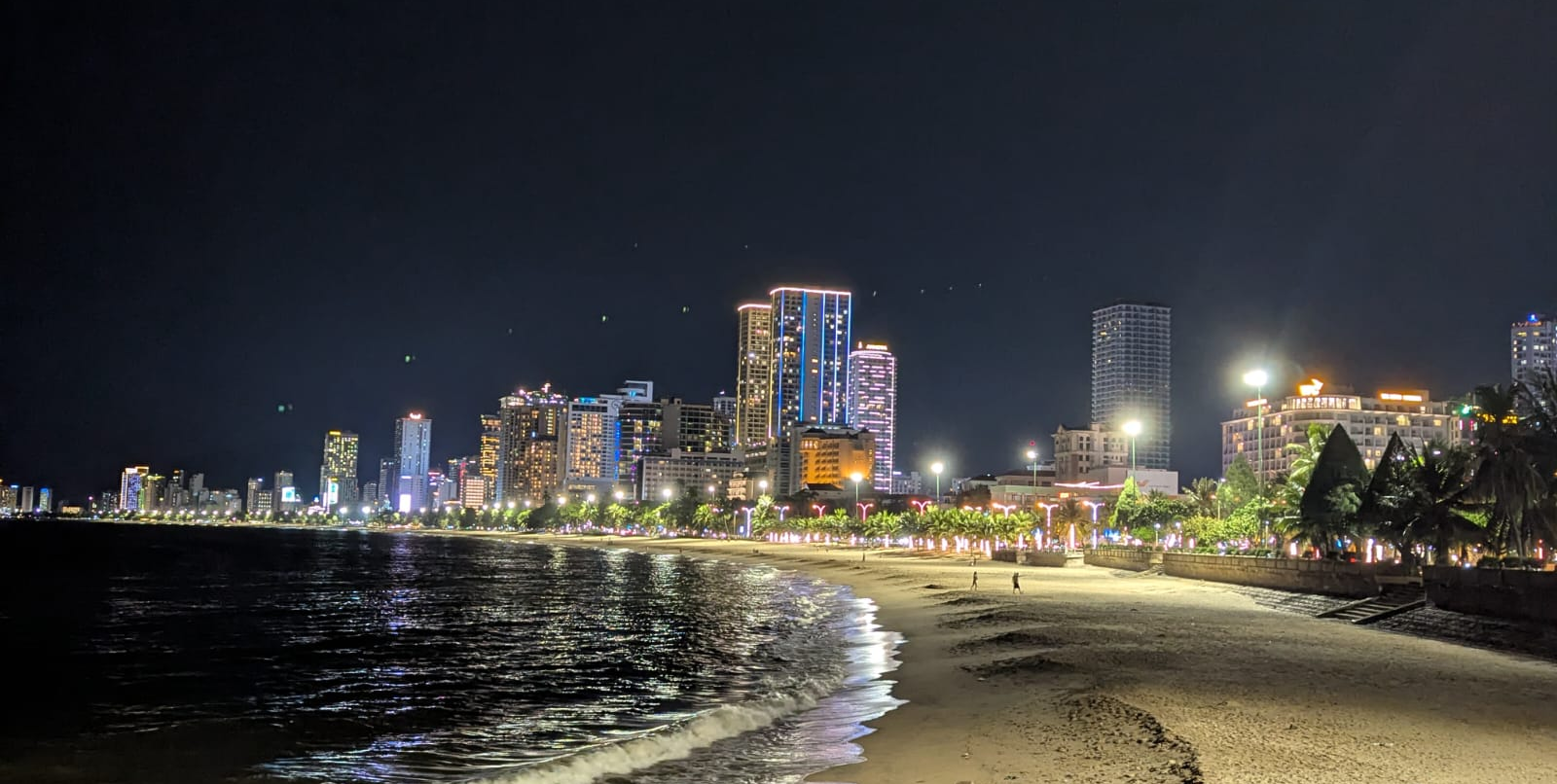
Nha Trang’s tourism peaks are shaped by different markets
I arrived in Nha Trang expecting July and August to be relatively quiet. That assumption came largely from other Southeast Asian beach destinations, where the summer monsoon often coincides with a weaker tourism period. That expectation did not last long. Hotels looked busy, the streets were crowded and the beaches packed.
The statistics confirm what I was seeing. In July 2024, Khánh Hòa — the province that includes Nha Trang as well as a major resort corridor stretching south toward Cam Ranh International Airport — recorded about 1.55 million guest arrivals in tourist accommodation — slightly more than January and February combined. Average occupancy reached 85%. This was clearly not a shoulder month.
The surprise was not the crowds themselves, but who was behind them. Winter accommodation demand was much more international, while the summer surge was overwhelmingly domestic. And unlike many beach destinations in Southeast Asia, July and August usually remain relatively dry in Nha Trang, coinciding with Vietnam’s main summer school holiday period.
This creates a seasonal pattern that is easy to misread from the outside. The question is not simply when Nha Trang is busy, but which market is driving demand at different times of the year — and what that means for hotels.
What the 2024 data actually show
The figures below are for Khánh Hòa Province rather than Nha Trang city alone. That distinction matters. However, a substantial share of the area's resort supply lies outside Nha Trang proper, particularly along the Bãi Dài–Cam Ranh corridor. With no comparable monthly city-level series, I use the provincial figures as a proxy for the broader Nha Trang–Cam Ranh accommodation market.
2024 is also useful because it is the last full year before Khánh Hòa and Ninh Thuận merged on 1 July 2025. There is one caveat: international tourism was recovering very quickly that year, so I treat 2024 as a case study rather than a permanent template for Nha Trang’s seasonality.
The figures make the contrast clear. January and February recorded 1.55 million accommodation guest arrivals, including 856,000 international and 692,000 domestic guests. July and August reached 2.87 million, about 85% more. Yet international accommodation guest arrivals were only 3.5% lower than in January–February. Domestic arrivals, by contrast, rose to 2.04 million, almost three times the winter level. The international share of accommodation arrivals fell from 55% to 29%.
International guests also stayed longer than domestic guests: around 3.3 nights per stay in January–February and 3.5 in July–August, compared with about 2.2 nights for domestic guests. As a result, international guest nights in July and August were slightly higher than in January and February, despite slightly fewer international guest arrivals.
March gives a sense of the drop between the stronger periods: about 619,000 guest arrivals, only 40% of July’s level. By June, arrivals had climbed to 1.30 million, with domestic guests accounting for roughly 72%. The summer peak was already taking shape before July.
These are not two versions of the same high season. Winter has a much more international guest mix. Summer is the much stronger period in terms of accommodation volume, and the increase is overwhelmingly domestic. The peak also coincided with a dense calendar of festivals and sporting events, which local tourism authorities identified as an additional driver of summer demand. Corporate and group travel is also highly visible in summer, although I have not found a monthly series that allows me to quantify its contribution.
A useful contrast: Phuket
Phuket offers a useful comparison because its seasonal pattern is much more conventional. The Tourism Authority of Thailand explicitly markets July and August as part of the “green season,” and Knight Frank’s 2025 hotel review shows occupancy peaking at around 92% in January, with June to September identified as the low season.
Khánh Hòa looks very different in summer. In 2024, average occupancy reached 79% in June, 85% in July and 79% in August. The figures are not directly comparable year for year, but the contrast is clear: Phuket’s strongest hotel demand is concentrated in the dry winter months, while Khánh Hòa’s accommodation market peaks in summer.
Vietnam as a whole also saw a clearer summer slowdown in international tourism: about 3.04 million international arrivals in January and February 2024, compared with roughly 2.6 million in July and August. The national and provincial series measure different things, so the comparison is only directional, but international accommodation demand in Khánh Hòa was just 3.5% lower in summer than in winter.
Khánh Hòa’s summer peak therefore combines two things: international demand that remains substantial and a much larger domestic market arriving at the same time.
What changed by 2026
The market has continued to evolve since the 2024 case study. Because Khánh Hòa became a larger province after the 2025 merger, the newer figures are not directly comparable with the old series. They are still useful for understanding who is coming now.
By the first seven months of 2026, South Korea was Khánh Hòa’s largest international source market, followed by Russia and China. That differs from Vietnam as a whole, where China remained the largest source market, ahead of South Korea and Russia.
The Russian recovery is particularly visible. In the first eight months of 2026, Khánh Hòa received more than one million visitors from Russia and other CIS markets.
That matches what I have seen on the ground. The Russian presence is hard to miss in Nha Trang. Russian appears on menus, shop signs and tourism businesses, and it is frequently heard in cafés, restaurants and on the beach. I also noticed how rarely English was spoken among tourists. It is only a personal observation, but the 2026 market data make it much less surprising.
What this means for hotels
For hotel operators, guest volume is only part of the story. A domestic-heavy summer and a more international winter can produce very different patterns in length of stay, booking lead time, distribution channels, room type and ancillary spending.
The 2024 figures show that summer is the stronger period for occupancy and accommodation volume. They do not tell us whether it is also the most valuable period in revenue or profitability terms. Without reliable ADR and RevPAR data, that would be an assumption.
The distinction still matters operationally. Hotels selling heavily to Vietnamese families and groups in summer are dealing with a different demand profile from properties relying more on international guests in winter. Pricing, room allocation, staffing and marketing do not necessarily need to follow the same seasonal playbook.
In my view, that is the more useful way to look at Nha Trang’s seasonality: not simply as a question of when demand is high or low, but of how the mix of demand changes through the year.
That mix also raises another question. Nha Trang’s international market is heavily concentrated around a limited number of source countries, while Western visitors appear relatively scarce on the ground. A destination can reduce its dependence on one season and still remain vulnerable if too much demand comes from a narrow set of markets.
Weather is part of Nha Trang’s seasonal story, but it is not the whole story. Domestic travel patterns and international source markets follow their own rhythms, and they do not peak at the same time. The next question may be whether Nha Trang’s challenge is still seasonality — or increasingly the diversification of its tourism markets.