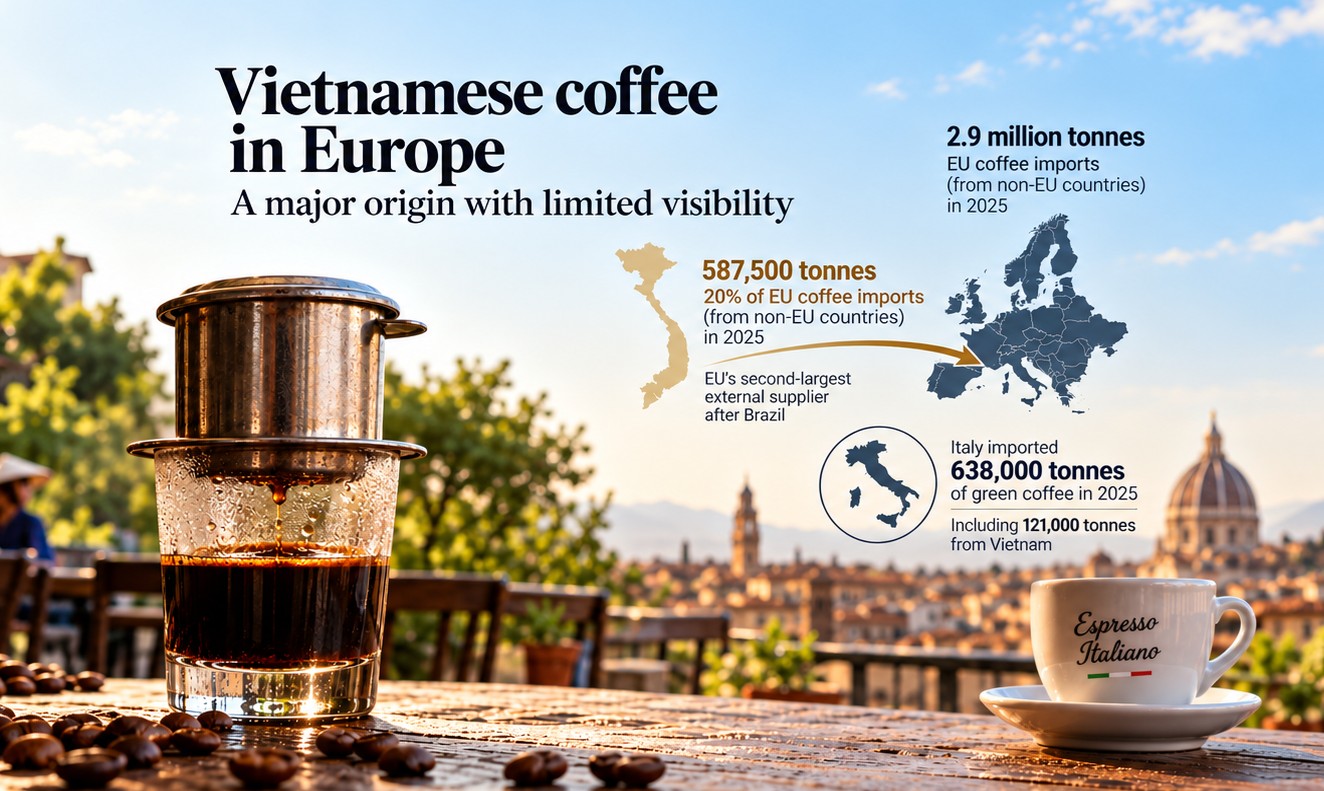
Vietnamese Coffee in Europe: A Major Origin with Limited Visibility
Vietnam is one of the EU’s major external coffee suppliers, but that is not how I first came to know Vietnamese coffee.
The object I probably associate most with it is a small metal filter. A phin is disarmingly simple: it sits directly on top of the glass while the coffee slowly drips through. You wait. There is no button to press and no thirty-second espresso ritual.
When I first travelled to Vietnam around ten years ago, the phin was only one part of what surprised me. The other was how deeply coffee seemed to be embedded in everyday life. Cafés were everywhere. People met friends, talked, watched the street and spent time over coffee well into the afternoon or evening.
As a European, I found something strangely familiar about it. The setting was obviously different, but the habit reminded me of Southern Europe: coffee as an excuse to sit somewhere rather than simply a dose of caffeine on the way to somewhere else.
I became fond of Vietnamese coffee — first the traditional preparations, later coffee made with espresso machines, as well as local variations such as cà phê muối (salted coffee) or cà phê dừa (coconut coffee). I simply enjoyed some of the coffees I drank in Vietnam more than much of the coffee I was used to drinking in Europe.
There was still something strange about that discovery. I had been drinking coffee for years and had travelled extensively, yet it took my first trip to Vietnam to realize not only how strong the country’s coffee culture was, but also how important Vietnam was to the global coffee industry.
Years later, walking through European supermarkets, I began noticing the same story from the opposite direction. Brazil was familiar. Colombia was familiar. Ethiopia and Costa Rica increasingly so. Vietnam was much harder to find. I initially assumed that Vietnamese coffee simply did not have much of a presence in Europe.
The trade data proved me wrong
According to Eurostat, the EU imported 2.9 million tonnes of coffee from non-EU countries in 2025. Vietnam supplied 587,500 tonnes — 20% of the total — making it the EU’s second-largest external supplier after Brazil.[1]
Eurostat’s figure covers coffee in different forms; the figures below refer specifically to green, non-decaffeinated coffee.
Italy provides a particularly interesting case. In 2025, it imported around 638,000 tonnes of green coffee from both EU and non-EU partners, including approximately 121,000 tonnes from Vietnam.[2]
For this article, VinaSources provided an analysis of TradeSparq shipment data covering Vietnamese green coffee exports to Europe. Between 2023 and 2025, the value of those shipments rose from about $1.88 billion to $4.66 billion, while shipment numbers increased by only 8% — suggesting that higher prices drove most of the increase.[3]
The Italian data adds another layer. Robusta accounted for 99.5% of the value of Vietnamese green coffee bought by Italian buyers between 2023 and 9 October 2026. Trading houses accounted for roughly two thirds of purchases, while Lavazza was the only coffee brand among the largest buyers identified in the data.[3]
Vietnamese coffee was already in Europe. I just wasn't seeing Vietnam on the label.
What consumers see
That contrast becomes particularly interesting in Italy, where coffee brands have built strong identities. An espresso can feel unmistakably Italian even though the coffee itself has been grown thousands of kilometers away.
To see how origin is presented to consumers, I reviewed 24 products listed on the official Italian websites of Lavazza, Kimbo, Caffè Borbone and Segafredo.
The sample was small and exploratory rather than representative of the Italian market, but the pattern was revealing. Four products named a specific producing country. Eight referred to broader geographical regions. Nine identified Arabica or Robusta without naming a country, and three gave neither a geographical origin nor a coffee species. None of the 24 explicitly named Vietnam.
That result needs some restraint. It does not tell us whether any particular blend contains Vietnamese coffee. Sourcing can change, blends are complex, and public product descriptions reveal only part of the supply chain.
Inside the supply chain
Vietnam, however, is far from invisible to the industry itself.
Caffè Borbone explicitly identifies Vietnam among the countries from which it sources coffee and works with ofi on an agricultural program in Vietnam’s Gia Lai province.[4] Kimbo is even more explicit: in a 2026 LinkedIn post, the company described Vietnam as a “strategic partner” and “a key origin” for its coffee sourcing, adding that it has been selecting Vietnamese coffees for many years.[5]
Somewhere between the producer, the trader, the roaster and the supermarket shelf, the meaning of origin changes.
One possible explanation lies in the role of Robusta in blends. When coffee is marketed primarily through the blend, roasting profile, body, crema or consistency, the story of a single producing country may matter less commercially.
Yet some of the same companies take a different approach with other products. In the sample I reviewed, countries including Brazil, Colombia, Uganda, Panama and India were explicitly identified in certain premium or origin-focused ranges.
That distinction interests me more than my original observation in the supermarket.
Vietnamese coffee clearly reaches the European coffee industry at scale. What is less obvious is how much of its Vietnamese identity remains visible as the coffee moves further along the value chain.
I still find it curious that it took a trip of thousands of kilometers for me to understand how important Vietnamese coffee was. Ten years later, when I walk through European supermarkets, I know that Vietnam is one of the major origins supplying Europe’s coffee industry, while still rarely encountering the word “Vietnam” on the products in front of me.
Perhaps the most interesting part of the story is what happens in between.
Sources & methodology
[1] Eurostat — Import value of coffee more than doubled in a decade, 1 October 2026.
https://ec.europa.eu/eurostat/en/web/products-eurostat-news/w/ddn-20261001-1
[2] World Bank WITS / UN Comtrade — Italy imports of coffee, not roasted or decaffeinated (HS 090111), 2025.
https://wits.worldbank.org/trade/comtrade/en/country/ITA/year/2025/tradeflow/Imports/partner/ALL/product/090111
**[3] VinaSources — Vietnamese Green Coffee in Europe: Trade Data Brief (Italy Focus), 9 October 2026.**
Data sourced from TradeSparq. Analysis by VinaSources.
[4] Caffè Borbone — official sourcing information and India/Vietnam agricultural programs.
https://www.caffeborbone.com/it-it/pages/i-programmi-in-india-e-vietnam
[5] Kimbo S.p.A. — official LinkedIn post on its sourcing relationship with Vietnam, 2026.
https://it.linkedin.com/posts/kimbo-spa_kimbo-coffee-vietnam-activity-7490741157480710144-T0tB
Product review: 24 product pages reviewed on the official Italian websites of Lavazza, Kimbo, Caffè Borbone and Segafredo, 6 October 2026.