Why Padel Took Off in Indonesia While Vietnam Embraced Pickleball
How did padel become an established local sport in cities across Indonesia, while pickleball achieved much broader popularity in Vietnam?
In 2024, I visited Bali, where padel was already becoming part of the island's international sporting and lifestyle scene.
Padel had become my favorite sport, and my interest extended well beyond simply playing matches. I had played the sport in Spain and Argentina, where it has been part of sporting culture for decades. In Spain, padel has overtaken tennis among licensed players, while in both countries, generations of players have grown up with the sport, from junior academies to local competitions.
This was a very different world from the one I encountered in parts of Asia, where finding a court — let alone a competitive match — could still be quite a challenge. I also completed my padel club manager certification, which made me particularly curious about how the sport was developing in different markets.
More recently, I discovered something rather unexpected in Yogyakarta, a city in central Java that I had never associated with padel.
The number of clubs was impressive, but what surprised me most was the local involvement. At one of the city's most striking new venues, Wii Social Hub, I spent an entire afternoon exploring a complex with six courts, a sauna, ice baths, recovery facilities and a huge coworking café. At another, much smaller club, I joined a highly competitive event with some very strong Indonesian players.
Both experiences challenged my initial perception of padel in Indonesia as a sport primarily associated with Bali's expatriate community. In Yogyakarta, every player I encountered was Indonesian, and the sport had clearly developed a genuine local following. The number of clubs was equally surprising: I identified around 40 venues across the greater Yogyakarta area through Google Maps and Reclub.
And Yogyakarta is far from an isolated case. Padel has expanded rapidly across Indonesia, with Jakarta emerging as a major market and cities such as Bandung and Surabaya developing their own networks of clubs. What initially caught my attention in Bali has clearly become a much broader national phenomenon. According to the 2026 FIP World Padel Report, Indonesia now ranks seventh worldwide, with approximately 3,300 padel courts — a remarkable position for a country where the sport was barely visible a few years ago.
Vietnam offered a very different experience
As a regular padel player, I naturally tried to find places to play during my travels. Outside the main hubs of Hanoi and Ho Chi Minh City, however, options were limited.
In Phu Quoc, I found a club with three courts, but during the low season, I struggled to find anyone to play with. There was no active matchmaking platform or organized open sessions that I could find. The courts were there, but finding a match was another matter.
In Nha Trang, the only available option I found was a multisport complex with two rather basic courts, where I joined a tournament run by a very active Russian-speaking community.
Eventually, I turned to pickleball, initially more out of necessity than genuine enthusiasm.
And I have to admit that the experience surprised me. Over several weeks, I joined pickleball socials in different cities, often playing for two or three hours for the price of a coffee or two. The sessions were easy to join, the atmosphere was welcoming, and most of the players were Vietnamese.
I was looking for padel, but pickleball turned out to be the sport I could play almost everywhere. That contrast made me curious about how differently these two racket sports have developed across Southeast Asia. Indonesia has developed a particularly strong padel scene, while Vietnam has embraced pickleball on a much broader scale.
Two sports, different paths to popularity
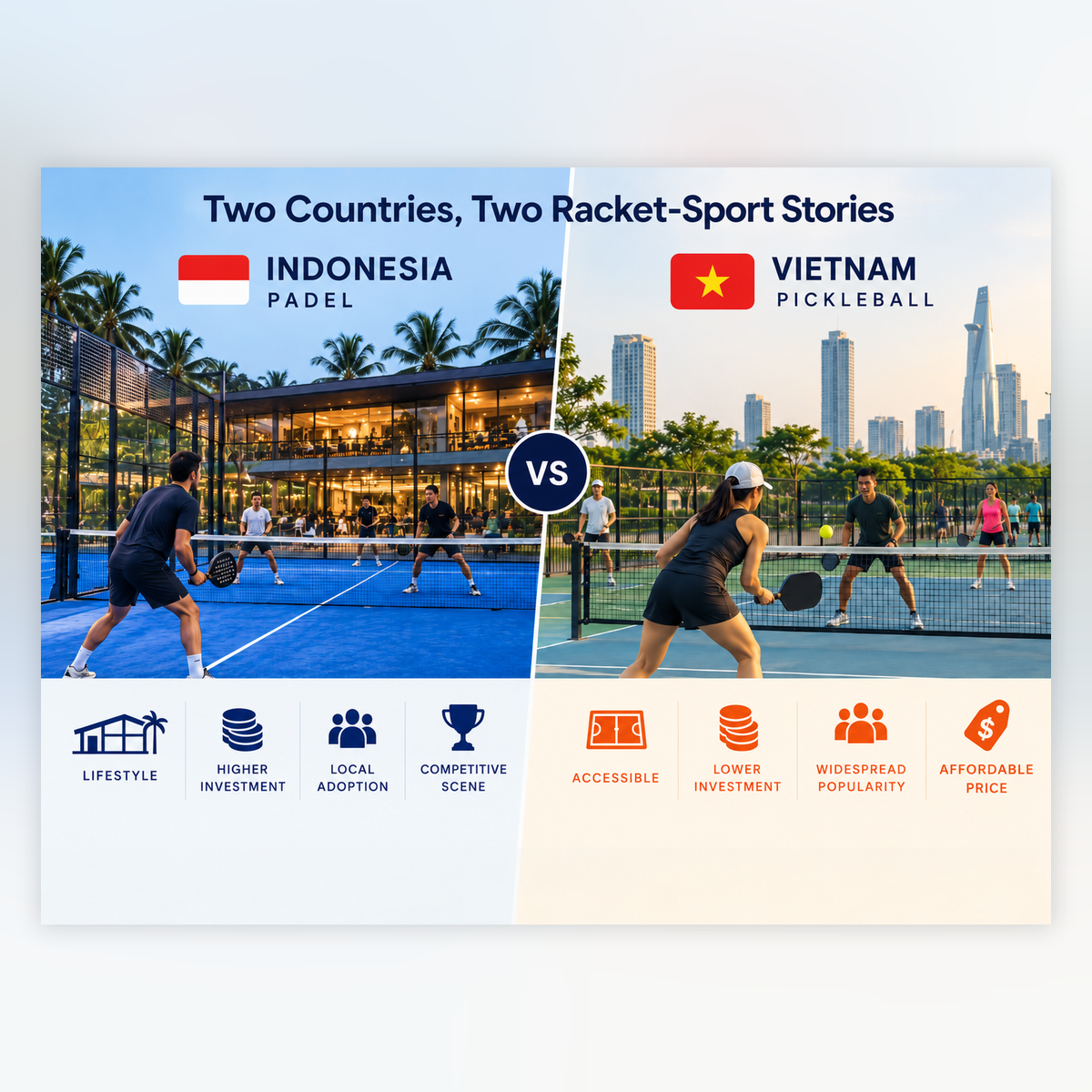
One striking difference was the type of infrastructure I encountered. Padel often comes with a strong lifestyle dimension, especially in Indonesia. Many clubs offer attractive facilities, cafés, social events and sometimes extensive wellness services. Wii Social Hub was the most impressive example I visited, although smaller clubs showed that a strong community and competitive atmosphere could be just as important as luxurious facilities.
Vietnamese pickleball clubs generally follow a more functional approach. After visiting more than twenty venues, I found that most focused primarily on the game itself, with relatively simple infrastructure. There were exceptions — one club even had saunas in the changing rooms — but the overall pattern was consistent.
Part of this difference is economic. Pickleball courts can often be created by adapting existing sports facilities, while padel requires specialized structures, glass walls and a considerably greater initial investment. But this raises an interesting question: why have Indonesian investors been so willing to commit to the more expensive sport?
One possible explanation lies in the business model. Beyond court rentals, some padel clubs aim to generate revenue through coaching, competitions, cafés and wellness services. The idea is not simply to offer a place to play, but to create a destination where customers spend more time and potentially more money. Whether this translates into profitable operations depends on factors such as occupancy rates, pricing and the ability to build a regular customer base.
Bali's international environment appears to have played an important role in introducing padel as an attractive sporting and social activity. International influences, urban lifestyle trends and local investors appear to have reinforced one another. More structured clubs, regular competitions and coaching networks then helped turn initial interest into regular participation.
Vietnam followed a different path. Pickleball appears to have surged in popularity from early 2024, supported by affordable facilities, social media exposure and organized games that made it easy for newcomers to participate. What particularly struck me was how easy it was to find people to play with, even when arriving in a city for the first time.
These observations suggest that infrastructure and investment alone do not explain the success of either sport. The ability to attract players, organize regular games and develop active communities may be just as important as the facilities themselves.
Is there room for padel in Vietnam?
Neighboring countries such as Thailand, Malaysia, the Philippines and Singapore appear to be following a different path, with padel and pickleball developing alongside each other, although at different scales and speeds. Neither sport needs to dominate the market for both to attract players and continue growing. This suggests that the success of one does not necessarily come at the expense of the other.
Vietnam already has the foundations of a padel market. Ho Chi Minh City has several established operators, including Vietpadel, PadelHub and Saigon Padel. Padel Hanoi is also developing in the capital, while smaller communities and facilities can be found in Da Nang, Phu Quoc and Nha Trang, among others.
The sport is gradually becoming more organized, with competitions, player rankings and a tournament calendar. Yet its international character remains striking: at the first official Padel Vietnam Open in December 2025, nearly 100 players participated, approximately 90% of whom were foreigners. A second national tournament, the Vietnam Padel Open – Heineken Cup 2026, followed in May 2026. It drew more than 100 local and international players, and while Vietnamese participation increased, international players remained prominent.
The question is whether padel can reach beyond its existing international communities and attract Vietnamese players.
The investment required for new courts remains a significant barrier, particularly when pickleball is already so widely available. But padel may not need to experience the same explosive growth to establish itself. A more gradual expansion, supported by coaching, competitions and committed local communities, could offer a promising path.
Having seen how enthusiastically Indonesian players have embraced padel, I find it difficult to imagine that the sport could not attract a broader Vietnamese audience. Vietnam already has a well-established racket-sport culture, while padel benefits from its long-standing association with some of the world's most celebrated footballers, giving the sport visibility far beyond its traditional markets.
Yet visibility alone is not enough. My experience in Phu Quoc highlighted a more practical challenge. Three new courts may attract holidaymakers during the high season, but what happens during quieter months when there is no established local community or easy way to find playing partners? For padel to develop a lasting presence in Vietnam, building an active community may be just as important as building the courts themselves.
One question remains: if some of today's pickleball enthusiasts were tempted to try padel, what would make them come back for a second match — and keep playing?
Sources & methodology
- Consejo Superior de Deportes (Spain) — Federated Sports Licences, official Spanish sports federation statistics, including padel and tennis. Official data
- International Padel Federation (FIP) — World Padel Report 2026, October 2026. Global padel infrastructure, market development and national court statistics. Official report
- PADEL1969 — 2026 FIP World Padel Report: Summary and Analysis, October 2026. Analysis of Indonesian court expansion, including the figure of 3,300 courts. Read analysis
- VnExpress International — Vietnam catches pickleball fever, July 22, 2024. Reporting on the rapid emergence of pickleball in Vietnam. Read article
- Vietnam Padel Association — VPA Rankings and Tournaments, 2026. Player rankings and organized competitions in Vietnam. Rankings | Tournament calendar
- Vietnam News — First-ever official padel tournament organised in Việt Nam, December 20, 2025. Nearly 100 participants, approximately 90% international players. Read article
- Vietnam News — International players dominate at Vietnam Padel Open 2026, May 18, 2026. More than 100 participants, with increased Vietnamese participation. Read article
Field observations: First-hand visits to padel facilities in Indonesia and Vietnam, and more than twenty pickleball venues in Vietnam. The approximate count of 40 padel venues in greater Yogyakarta is based on a personal review of Google Maps and Reclub listings, rather than an official census. Market interpretations and business-model explanations are presented as hypotheses informed by these observations.